
Mission
Build a durable backend-up mental model.
The learner wants to understand how visible text becomes model input, how inference produces output, how serving constraints shape systems, and how later topics such as retrieval, adaptation, safety, and evaluation fit together.
Why lesson 0001 came first
Establish the request-trace spine before zooming in.
Tokenization, vectors, transformer computation, logits, decoding, and serving pressure would otherwise be disconnected terms. One bounded trace from visible text to streamed output created shared boundaries for later lessons. This was a provisional map decision, not a fixed-curriculum rule.
Sourced lesson
Name the form of information at every major boundary.
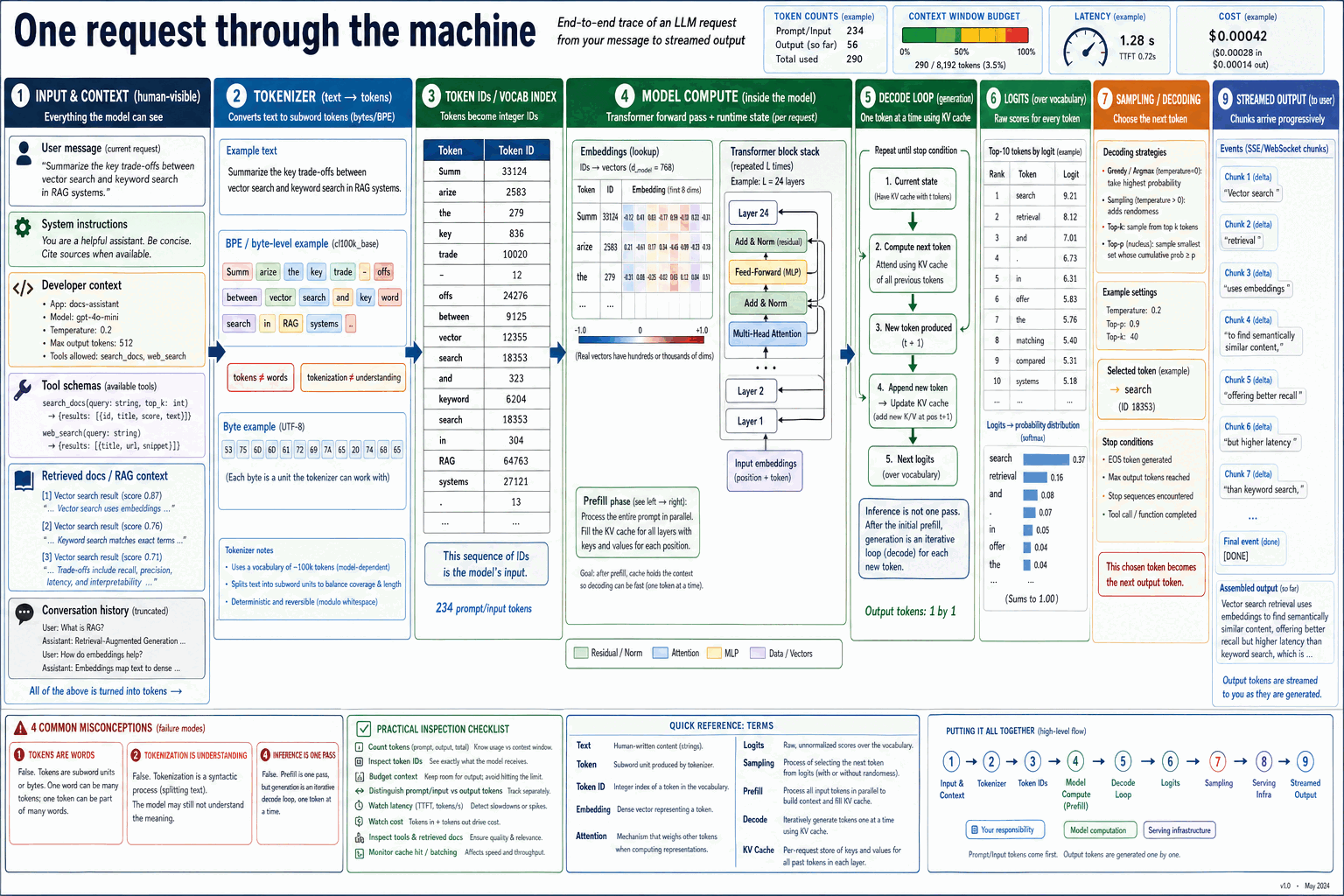
Visible text → token pieces → token IDs → learned vectors → transformer computation → logits → sampled output token
After the input is processed in a prefill phase, generation repeats a next-token decode step until a stop condition is reached. Exact toy IDs and scores are illustrative, not model claims.
Teaching artifact
The poster supports boundary tracing and later recall.
It places input context, tokenization, IDs, vector lookup, transformer computation, logits, selection, and streamed output on one surface. The poster is one teaching artifact inside the loop. Its readiness does not prove learner understanding, and the poster is not Curio by itself.
Understanding check and evidence
Four boundary questions, one modest conclusion.
The check asked what first turns visible text into model-visible pieces, what an embedding lookup receives, what logits represent, and why output length affects latency. The retained public-safe record contains no raw response. It records four criterion-level observations: visible text was distinguished from tokenizer output, integer token IDs from learned vectors, logits from probabilities or final output, and longer output from additional decode steps. All four criteria were met.
That evidence supports the basic request trace and its major boundaries as shared vocabulary. Confidence is moderate because the result comes from one reviewed check without a repeated transfer task or independent implementation. It does not prove mastery of tokenization, transformer mathematics, inference serving, production architecture, or durable transfer.
Artifact readiness and learner understanding are separate. A ready lesson begins with no understanding evidence.
Safe future assumption
Later lessons may use the request-trace vocabulary.
Text, tokens, token IDs, vectors, logits, and repeated decode may now be used as shared terms. No deeper mastery is assumed.
Evidence-causal map revision
Evidence evidence_request_trace_0001 closed the introductory request-trace node. Revision revision_tokenization_next_0001 moved the frontier to tokenization because token pieces and IDs were recognizable, while their model-specific behavior, context pressure, cost, and latency consequences still needed focused study.
If the learner had collapsed the tokenizer, model, and serving boundaries, understanding would remain uncertain. Curio would record the gap, offer a smaller sorting exercise, and keep the map in place.